Electrooptical Devices Based on Gel-Glass Dispersed Liquid Crystal (GDLCs)
A pioneering development at SGG, is based on a new concept of “electroactive organic molecules in glasses”. In other words, the possibility of manipulating the optical properties of molecules by means of an external electric field. These new materials can be used in a very wide range of applications.
This development consists on the microencapsulation of liquid crystal (LC) droplets dispersed in Sol-Gel glasses (films of 2-3 μm of thickness). The first prototypes of optical switches controlled by electric field prepared with this new material have been developed in our laboratory and patented under the name of GDLC® (Gel-glass Dispersed Liquid Crystal).
The operation of a GDLC (see Figure) is based on the strong light dispersion (scattering) of the device in the resting or opaque state (OFF), that becomes transparent when an external electric field is applied (ON-state). No polarizers are needed for its operation and switching times between OFF and ON states are about 1 ms. Some of the remarked GDLC applications are switches or optical shutters, visualization screens, and the so-called “intelligent windows” for application in houses or offices.
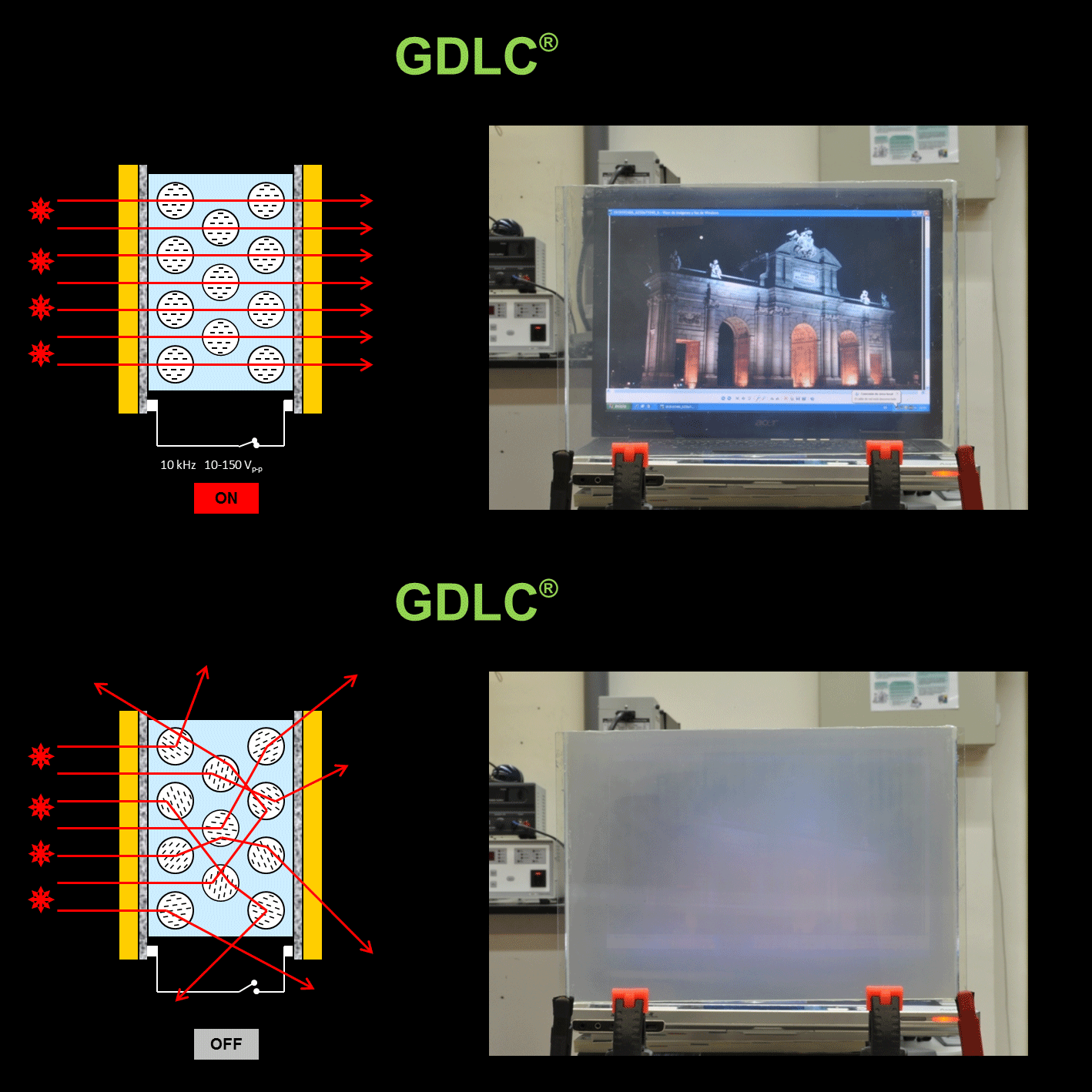
Operation of a GDLC device switching between the opaque (OFF) and transparent (ON) states. The incident light is dispersed by the LC microdroplets in the OFF state while during the application of an electric field a transparent material is obtained
The LC macroscopic ordering in the formed droplets is controlled by the surface anchoring induced by the hybrid silica surface:
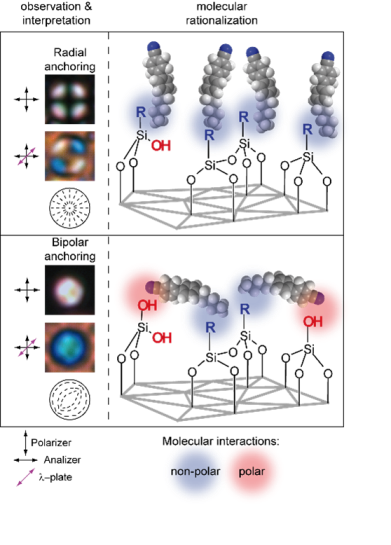
Effect of the surface composition on the orientation of the LC molecules in the droplets
These materials show a transition in the molecular configurations of the LC at a specific temperature that can be interpreted as a surface anchoring transition. The temperature at which this transition takes place was found to depend strongly on the nature and amount of the modifying groups in the matrix. The bipolar configuration is preferred at low organic contents and high temperatures, while the radial configuration is obtained at high organic contents and low temperatures.
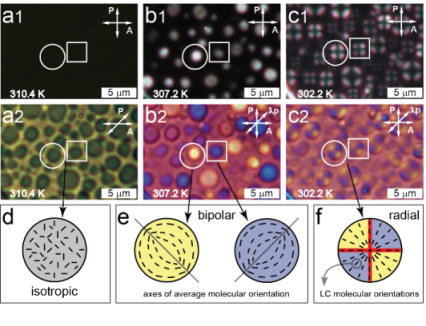
Different LC configurations in the droplets (isotropic, bipolar and radial)
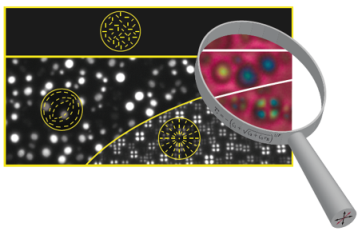
LC configurations vs. composition of the matrix and temperature