Home » Research Lines » INNOVAGLASS

INNOVAGLASS

Electrochromic and Energy-Efficient Smart Windows

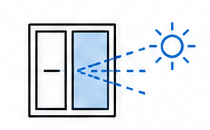
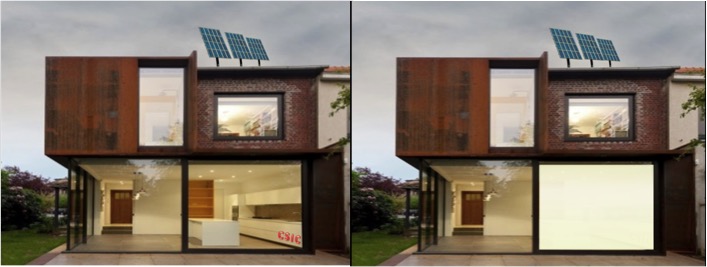
CSIC offers a device capable of controlling the amount of light passing through a window (Smart Windows), giving the desired privacy instantly or acting as a protector against solar radiation. Its operation can be activated with a remote controller and can be applied in intelligent buildings as windows or doors, as office partition panels, sliding doors, light regulatory elements or protection against light, information display screens, etc. Its easy preparation and high photostability result in low manufacturing costs and the possibility of using the invention in both, indoors as exterior facade.

Problem

Buildings account for around 40% of global energy consumption. with a large share due to heating, cooling and lighting. Conventional windows cannot adapt to changing light and heat conditions, leading to high energy demand and reduced occupant comfort.

Technology

The CSIC technology here described is unprecedented. The operating principle is based on the controlled activation of a combination of chemical and physical reactions, which give rise to a change in the transmittance of the new device (opaque-transparent switching.) As a result, the invention is able to control or regulate the amount of sunlight passing through the glass to reduce visibility through a window (smart window). It has response times of seconds and it is faster than most conventional smart windows.

This kind of devices are appropriated to reduce the use of air conditioning in a building in summer and heating in winter, thus providing an optimization of energy resources in buildings.

Its simple and easy preparation (No use of Liquid Crystal or ITO conductive glasses) results in very low manufacturing costs with the great advantage of using less expensive materials than those used in other conventional smart windows.

Main Features and advantages

  • This invention opens the door to mass production of large area structures (square meters) in smart windows market with the great advantage of using less expensive materials than the conventional ones used in other smart windows.
  • Response times of seconds
  • High photostability when exposed to sunlight
  • Environmentally friendly nature of the materials used for fabrication
  • Possibility of using the devices on flexible substrates or on any other surface, flat or curved, glass or polymer, etc.

Applications

This technology can find application in the market of energy efficient windows, windows, roof panels, skylights, mirrors, for applications in architecture, decoration of interiors and, exteriors of buildings, doors, partitions between rooms in offices or homes, regulatory elements or light protection, information display screens, intelligent buildings, car windows…

Status (Trl)

1 2 3 4 5 6 7 8 9
Technology validated in laboratory environment. Prototypes demonstrated under relevant conditions.

Funding

Our research is supported by competitive national and international funding

  • Horizon Europe – SmartWindows Project
  • MCIN- PID2022-XXXX*
  • Comunidad de Madrid – TALENTO Proqram
  • Industry collaborations and contracts

Selected Publications

E. Castellón, M. Chavarría, V. de Lorenzo, M. Zayat and D. Levy, An Electro-optical Device from a Biofilm Structure Created by Bacterial Activity, Advanced Materials 2010, 22(43), 4846-4850.

E. Castellón, M. Zayat and D. Levy, A model for the study of the optical transmission dynamics of liquid crystals dispersions under the influence of an electric field, European Physical Journal E 2010, 32, 81-87.

E. Castellón, M. Zayat and D. Levy, Molecular configuration transitions of a nematic liquid crystal encapsulated in organically modified silicas, Physical Chemistry Chemical Physics 2009, 11, 6234-6241.

Interested in collaborating or learning more?
Get in touch with us.